 Alex Anag
GTA 6: how a whole world fits into 33.3 milliseconds
An open-world game has 33.3 ms for every frame. What that means for physics, memory and level of detail.
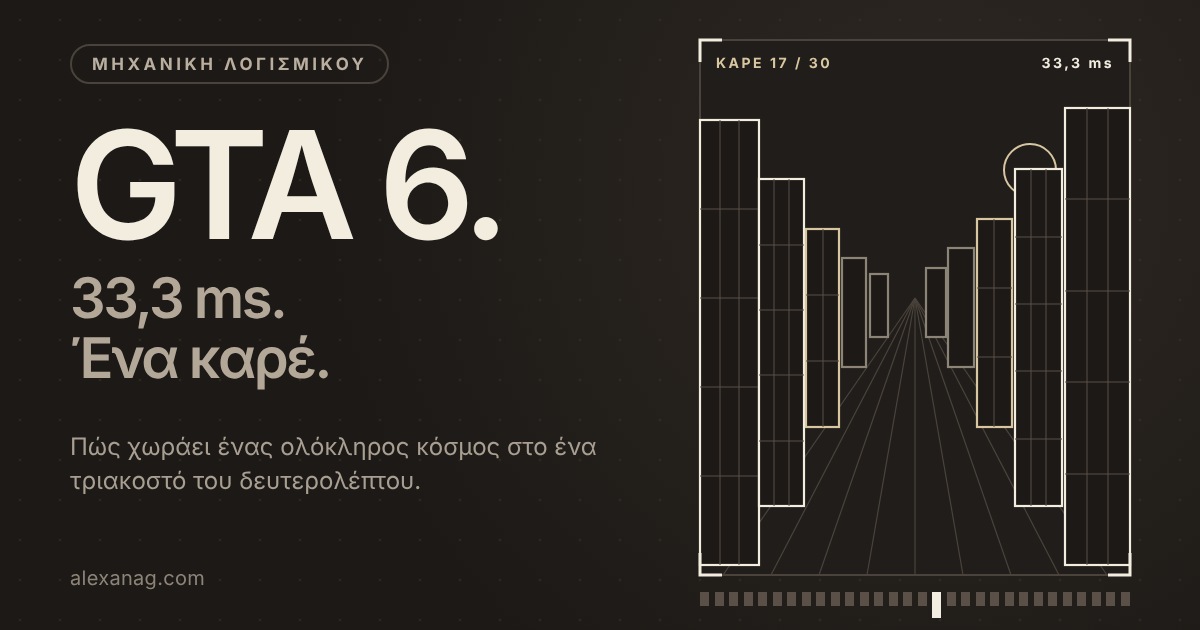
GTA 6 launched on Thursday 19 November 2026 for PlayStation 5 and Xbox Series after two delays, according to Al Jazeera. A few days earlier Rockstar said it targets 30 frames per second, as outlets reported. For a computer scientist it is a good occasion to look at what it means for a program to run in real time.
Rockstar has not published technical details about the GTA 6 engine. What follows are general game-engine techniques, and the figures are schematic.
The frame
The picture we see is a series of still frames. At 30 frames per second each frame lasts 1000 ms ÷ 30 = 33.3 ms. Within that time the engine must compute physics (movement, collisions), the artificial intelligence of pedestrians and vehicles, and the rendering of every pixel. If it cannot keep up, some frames arrive late: the image freezes for a moment or the motion looks jerky (known as stutter).

Figure 1. The budget of one frame. The share per task is illustrative, not a measurement of GTA 6.
30 or 60 frames?
At 60 frames the time drops to 16.7 ms: the same workload must fit in half the time or become lighter. The choice is a trade-off between smooth motion and the detail of each image. gHacks notes that Rockstar's post does not mention a 60 fps mode.
Memory and detail
An open world does not fit entirely in RAM. With streaming, what is near the player is loaded and, as the player moves, new parts arrive from the disk. With Level of Detail (LOD) an object has several versions and, the farther away it is, the simpler one is used. This way time and memory are spent where they are visible.

Figure 2. Streaming: what is near the player goes into RAM.

Figure 3. LOD: fewer polygons as the object moves away.
For class discussion
The budget of a frame is a simple engineering problem: the time is fixed and the tasks must fit inside it. Try it with numbers:
- Compute the time per frame at 24, 30, 60 and 120 frames per second (1000 ÷ fps).
- Suppose physics takes 8 ms and pedestrian AI takes 6 ms. How much time is left for rendering at 30 frames, and how much at 60?
- What would you give up to reach 60 frames: rendering detail, number of pedestrians or view distance? How do streaming and LOD help here?
Answer to the second question: about 19.3 ms at 30 frames and 2.7 ms at 60. At 60 frames almost no time is left for rendering, which is why the engine must do less work.
Conclusion
A game is not only graphics. It is a trade-off between time, memory and detail, with measurable limits that must be met. That is the essence of software engineering.
Sources
Al Jazeera: the GTA 6 launch on 19 November 2026.
gHacks: Rockstar's statement on 30 fps on consoles.
The Big Lead: report on the 30 fps target.
Gregory, Game Engine Architecture (Routledge): the standard text on game-engine systems.
Luebke et al., Level of Detail for 3D Graphics (O'Reilly): the LOD technique.